





































































































































































































































































































Biology – Classification Of Organisms – Notes For W.B.C.S. Examination.
জীববিজ্ঞান – জীবের শ্রেণিবিন্যাস – WBCS পরীক্ষা।
- The technique of classifying organisms is known as Taxonomy.Continue Reading Biology – Classification Of Organisms – Notes For W.B.C.S. Examination.
- Taxonomy is made up of two words i.e. ‘Taxis,’ which means ‘arrangement’ and ‘Nomos,’ which means ‘method.’
- The Swedish botanist Carolus (Carl) Linneaeus has developed the modern taxonomic system.
- Linneaeus has developed the following hierarchy of groups to explain the taxonomy −
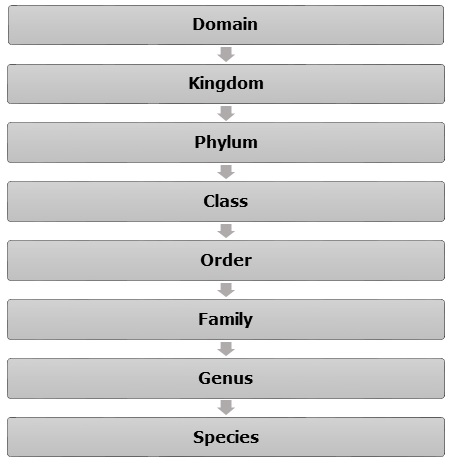
- In this hierarchy, Domain is the highest order and the broadest category and Species is the lowest order category.
- Further based on the difference between eukaryotes and prokaryotes (cells) ‘Domains’ classified into three broad categories namely −
- Archea(Archeabacteria) − It comprises the bacteria that live in extreme environments.
- Eubacteria − It comprises the bacteria that found in everyday life.
- Eukaryote − It comprises almost all the world’s visible living things.
- The above given three domains are further categorized into Five following Kingdoms −
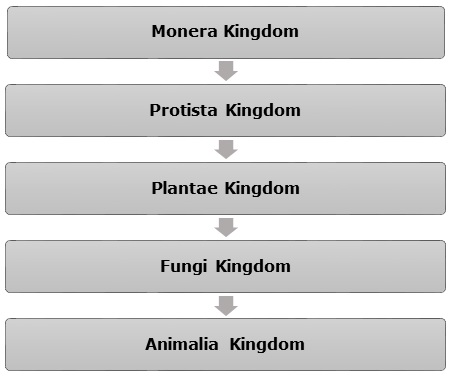
- Let’s discuss each kingdom in brief −
- Monera − It comprises the unicellular organisms, e.g. bacteria.
- Protista − Similar to monera (unicellular), but more developed and complex. It contains nucleus.
- Plantae − All plants from smallest (such as algae) to the largest (such as Pine, Eucalyptus trees, etc.) are studied under this kingdom.
- Fungi − It is a group of eukaryotic organisms that comprises microorganisms such as yeasts, molds, and mushrooms. The organisms of this kingdom do not make their food, they are basically parasites.
- Animalia − It includes all the multicellular and eukaryotic organisms (of animal group). It is also known as Metazoa.
Binomial Nomenclature
- The naming culture (of different organisms) practiced uniformly across the world is known as binomial nomenclature.
- Binomial Nomenclature largely consists of two words – the first word beginning with a capital letter and known as genus (of the organism) and the second word begins with lower case letter and defines the species of the organism.
- Binomial Nomenclature must be written in italic and also known as scientific name.
- For example, the binomial nomenclature of human is – Homo sapiens; tiger – Panthera tigris, etc.
Eukaryotes and Prokaryotes
- Cells are fundamentally categorized by prokaryotes and eukaryotes.
Prokaryotes
- Prokaryotes are the smallest and simplest type of cells.
- Prokaryotes have no true nucleus and no membrane-bound organelles. E.g. Bacteria.
- Prokaryotes’ Genome consists of single chromosome.
- Reproduction is asexual; basically mitosis type.
Eukaryotes
- Eukaryotes are complex in structure.
- Eukaryotes have nuclei and membrane-bound organelles.
- Eukaryotes’ Genome consists of numerous chromosomes.
- Reproduction is sexual; by mitosis and meiosis.
Our own publications are available at our webstore (click here).
For Guidance of WBCS (Exe.) Etc. Preliminary , Main Exam and Interview, Study Mat, Mock Test, Guided by WBCS Gr A Officers , Online and Classroom, Call 9674493673, or mail us at – mailus@wbcsmadeeasy.in
Visit our you tube channel WBCSMadeEasy™ You tube Channel
Please subscribe here to get all future updates on this post/page/category/website