










































































































































































































































































































Biology – Tissues – Notes For W.B.C.S Examination.
জীববিজ্ঞান – টিস্যু – WBCS পরীক্ষার জন্য নোট।
- A group of cells that are similar in structure and work together to accomplish a particular function is known as tissue.Continue Reading Biology – Tissues – Notes For W.B.C.S Examination.
- Tissues are categorized as −
- Plant Tissue &
- Animal Tissue
- Let’s discuss them in brief −
Plant Tissue
- Following are the major types of plant tissue −
- Meristematic Tissues
- Permanent Tissues
- Simple Permanent Tissues
- Parenchyma
- Collenchyma
- Sclerenchyma
- Epidermis
- Complex Permanent Tissue
- Xylem
- Phloem
- Simple Permanent Tissues
Meristematic Tissue
- Meristematic tissue mainly consists of actively dividing cells, and helps in increasing the length and thickening the stems of the plant.
- Meristematic tissue, commonly, present in the primary growth regions of a plant, for example, in the tips of stems or roots.
- Depending on the region (where the meristematic tissues are found); meristematic tissues are classified as apical, lateral, and intercalary (see the image given below).
- Apical meristem (as shown in the above image) is present at the growing tips of stems and roots and helps in their growth.
- Lateral Meristem is found in stem or root region and helps in their growth.
-
Intercalary meristem is found at the base of the leaves or internodes (on twigs) and helps in growth.
Permanent Tissue
- Cells of meristematic tissue later differentiate to form different types of permanent tissue.
- Permanent Tissue is further categorized as −
- Simple Permanent Tissue and
- Complex Permanent Tissue
Simple Permanent Tissue
- Simple Permanent Tissue further categorized as −
- Parenchyma
- Collenchyma
- Sclerenchyma
- Epidermis
- Parenchyma tissue provides support to plants and also stores food.
- Sometimes, parenchyma tissue contains chlorophyll and performs photosynthesis, in such a condition, it is known as collenchyma.
- The collenchyma tissue provides flexibility to plant and also provides mechanical support (to plant).
- The large air cavities, which are present in parenchyma of aquatic plants, give buoyancy to the plants and also help them float, are known as aerenchyma.
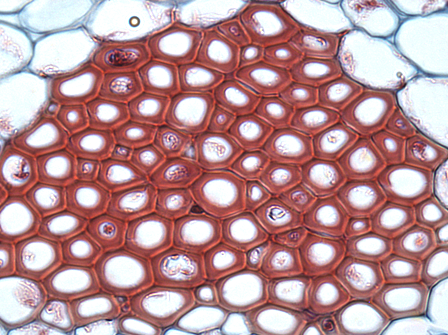
- The Sclerenchyma tissue makes the plant hard and stiff. For example, the husk of a coconut is made up of sclerenchymatous tissue.
- The cells of Sclerenchyma tissue normally are dead.
- The outermost layer of cells is known as epidermis.
- The epidermis is usually made up of a single layer of cells.
- The entire surface of a plant has the outer covering of epidermis, which protects all the parts of the plant.
Complex Permanent Tissue
- The complex tissue, normally, consists of more than one type of cells which work together as a unit.
- Complex tissues help in the transportation by carrying organic material, water, and minerals up and down in the plants.
- Complex Permanent Tissue is categorized as;
- Xylem and
- Phloem
- Xylem, normally, consists of tracheid, vessels, xylem parenchyma, and xylem fibers.
- Xylem is accountable for the conduction of water and mineral ions/salt.
- Phloem, normally, is made up of four types of elements namely −
- Sieve tubes
- Companion cells
- Phloem fibers and
- Phloem parenchyma
- Phloem tissue transports food from leaves to other parts of the plant.
Our own publications are available at our webstore (click here).
For Guidance of WBCS (Exe.) Etc. Preliminary , Main Exam and Interview, Study Mat, Mock Test, Guided by WBCS Gr A Officers , Online and Classroom, Call 9674493673, or mail us at – mailus@wbcsmadeeasy.in
Visit our you tube channel WBCSMadeEasy™ You tube Channel
Please subscribe here to get all future updates on this post/page/category/website